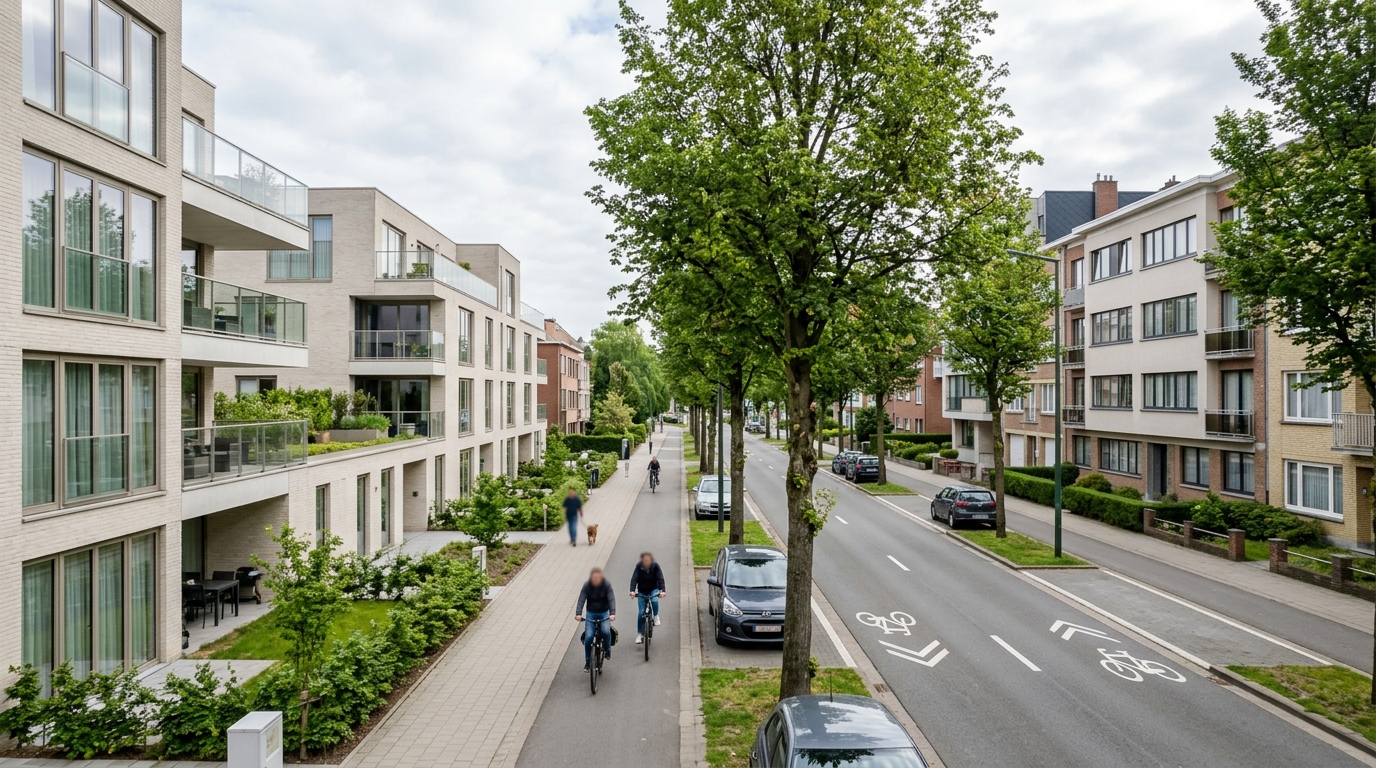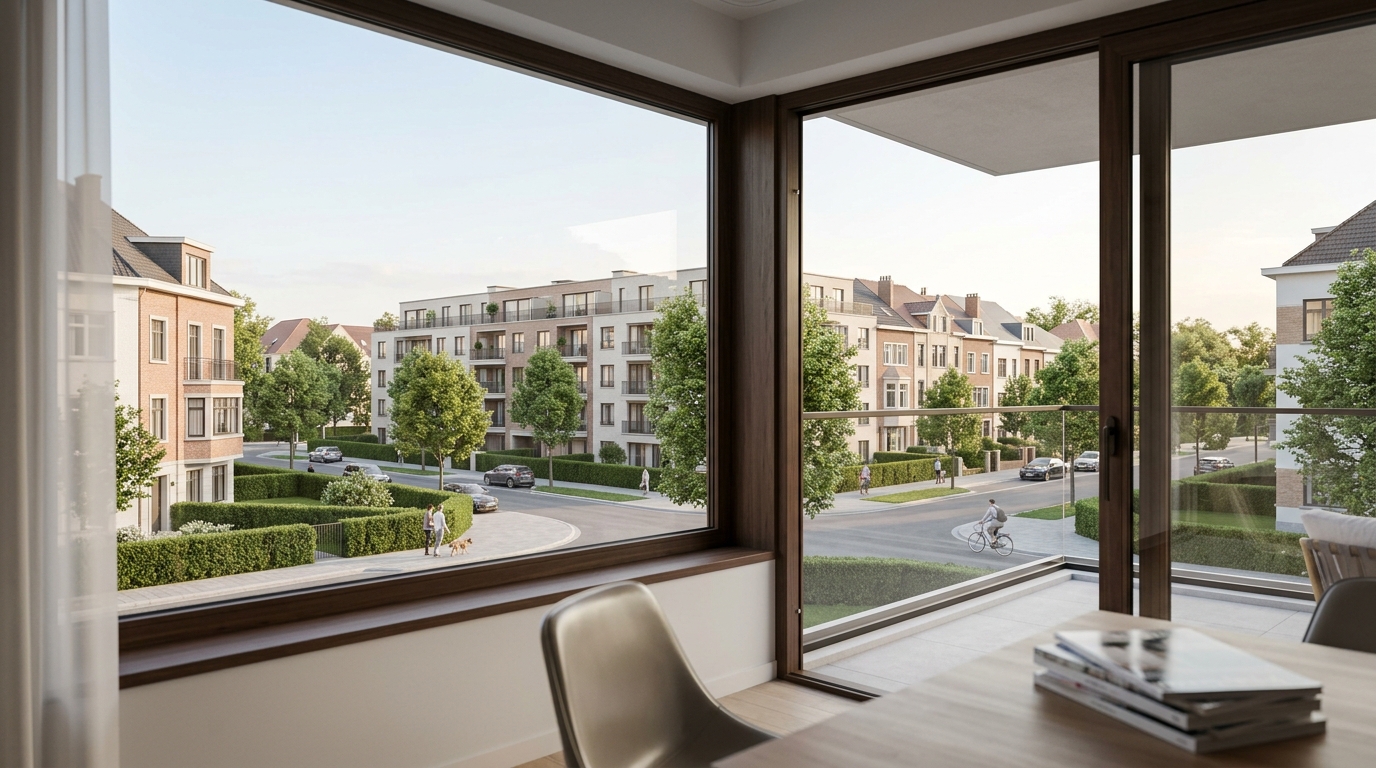
Woluwe-Saint-Lambert is already one of the most sought-after residential municipalities in eastern Brussels. But an established municipality can also experience underlying shifts. In Woluwe-Saint-Lambert, this shift has a name: the conversion of former office buildings into housing, transforming certain formerly commercial sectors into residential neighbourhoods. Added to this is an original development project in the heart of the municipality. Here is a factual reading of these dynamics.
A methodological precaution first: identifying a sector in transformation never guarantees future capital gains, and urban projects can experience delays. This article describes what is concretely underway, without predicting price movements. For context, according to the Federation of Notaries, the median house in Woluwe-Saint-Lambert reaches 680,000 euros in 2025 and the median apartment 335,000 euros, placing the municipality on the regional podium for both property types.
Marcel Thiry and Val d’Or: the changing face
It is in the north of the municipality, around Avenue Marcel Thiry and Val d’Or, that the transformation is most visible. This sector, long marked by office buildings, now sees several of these buildings converted or replaced by housing. Businesses are gradually moving away, making room for a residential vocation.
Several construction sites illustrate this shift. A residential building developed by BESIX on Avenue Marcel Thiry provides for approximately 104 dwellings, as many parking spaces and a shop. A former office building in the same sector is being converted into a complex of approximately 107 studios, apartments and penthouses, designed to achieve a high level of energy performance. This transformation, which is accompanied by a growing need for schools and nurseries in the neighbourhood, makes Marcel Thiry the most dynamic sector in the municipality.
The Saint-Lambert eco-neighbourhood: an unprecedented approach
In the heart of the municipality, around Place Saint-Lambert and Chaussee de Roodebeek, the municipality has launched an eco-neighbourhood project. Its uniqueness: it applies to an already built-up neighbourhood, which is a first in the Brussels Region, where eco-neighbourhoods are usually born on brownfield sites.
The stated objective is to manage the announced urban changes rather than suffer them, and to strengthen green and blue corridors, meaning the preservation and extension of green spaces and rainwater collection systems along the Woluwe valley. The project, developed in a participatory manner with residents, anticipates several developments in the sector, including the extension of a tram line, the conversion of office buildings into apartments and the extension of the Woluwe Shopping Center. For residents, this is the promise of a greener, calmer living environment.
Roodebeek and the Woluwe Shopping Center
The Roodebeek sector, served by the metro, remains one of the most practical hubs in the municipality. The manager of the Woluwe Shopping Center has carried out an extension project for the shopping centre, designed in particular to facilitate pedestrian access from the metro station. A strengthened commercial hub, combined with metro service, reinforces the residential attractiveness of the surroundings, already sought after for their mix of shops, transport and green spaces such as Roodebeek Park.
Georges-Henri: the shopping street axis
Straddling Woluwe-Saint-Lambert and Schaerbeek, the Georges-Henri quarter is organised around its lively shopping avenue. It is a sought-after sector for its neighbourhood life and accessibility, where residential demand remains strong. The historic pressure of offices on certain nearby streets has sometimes weighed on the population, which recent conversions to housing are tending to correct.
The underlying trend: from office to home
The common thread running through these developments is clear: in Woluwe-Saint-Lambert, part of the ageing office stock is being transformed into housing, often at a good level of energy performance. For the market, this means a new supply of recent, energy-efficient properties, in a municipality where supply otherwise renews little. This type of property meets precisely the current demand, sensitive to charges and energy compliance.
On the mobility side
Woluwe-Saint-Lambert benefits from solid metro service, with several stations on its territory, and projects to strengthen the tram network. This accessibility, combined with proximity to major roads and the airport, is one of the municipality’s lasting assets, regardless of the uncertainties of major regional construction projects.
What this means if you are buying or selling
If you are buying, sectors undergoing conversion such as Marcel Thiry offer recent, high-performance properties, where the rest of the municipality mainly offers older buildings requiring renovation. However, base your decision on construction sites that are actually underway rather than on merely announced projects. If you are selling, the quality of the living environment and the scarcity of supply remain your best assets, provided you rely on a valuation based on actual transactions in your neighbourhood.
Do you own a property in Woluwe-Saint-Lambert and wonder what it is worth in its precise neighbourhood? Request your free valuation; a local agent will contact you within 48 hours.
This article offers a factual reading of current projects at the date of writing. It does not constitute investment advice and does not prejudge future price developments.
Frequently asked questions
Which neighbourhoods are being transformed in Woluwe-Saint-Lambert?
The most dynamic sector is Marcel Thiry and Val d’Or, in the north, where former office buildings are being converted into housing. In the centre, an eco-neighbourhood project around Place Saint-Lambert aims to green and calm the neighbourhood.
What is the Saint-Lambert eco-neighbourhood?
It is a participatory municipal project applied to an already built-up neighbourhood, a first in the Brussels Region. It aims to strengthen green spaces and rainwater management along the Woluwe valley, while managing upcoming urban developments.
How much does a property cost in Woluwe-Saint-Lambert?
According to the Federation of Notaries, the median house reaches 680,000 euros in 2025 and the median apartment 335,000 euros, among the highest in the Region. The price of a specific property depends on its neighbourhood, condition and energy performance.
Catégories